All Solutions
SOLUTION Surveillance Defense Edge AI

Persistent Edge Surveillance & Multi-Sensor Fusion

Empowering Commercial, Government, and Defense Operations with Persistent, Real-Time Situational Awareness

Schedule Technical Consultation View Projects

The industry's challenges — and how we answer them.

Challenge 01

Sensor overload without actionable intelligence.

Most surveillance deployments confuse data collection with operational security. Systems stream endless feeds of high-definition video, radar returns, and RF telemetry into control rooms, overwhelming operators with raw data. The gap between "data is being recorded" and "a threat is identified and acted upon" creates cognitive fatigue and leads to missed events.

RT Projects Response

We integrate Edge AI and automated target classification directly at the sensor level. Raw environmental feeds are processed locally, transforming continuous multi-gigabit video and signal streams into lightweight, decision-ready telemetry and high-confidence alerts before they ever reach the C2 display.

Challenge 02

High false-alarm rates in cluttered environments.

Perimeters, borders, and industrial facilities are surrounded by benign activity—wildlife, atmospheric anomalies, authorized traffic, and environmental noise. Single-sensor surveillance systems that rely solely on motion detection continuously "cry wolf," causing operators to mute alerts or ignore critical warnings.

RT Projects Response

We implement multi-spectral sensor fusion across independent sensor families (EO/IR, radar, RF spectrum, and acoustic mesh nodes). A target must survive cross-verification and behavioral classification across multiple modalities before an alert is escalated, practically eliminating false positives in complex operational theaters.

Challenge 03

Bandwidth bottlenecks and latency across remote perimeters.

Transmitting continuous high-definition video from remote borders, offshore facilities, or tactical forward positions back to central command requires massive network infrastructure. Over satellite links or tactical radios, bandwidth limitations introduce severe video lag, making real-time threat response impossible.

RT Projects Response

We engineer real-time software on constrained edge hardware to process data at the point of capture. By transmitting low-bandwidth threat metadata (under 100 Kbps) instead of uncompressed HD video streams, we reduce network load by up to 98% while maintaining sub-30 ms glass-to-glass processing latency.

Challenge 04

Proprietary vendor boxes that do not integrate.

Surveillance hardware is frequently acquired piecemeal from different manufacturers, resulting in isolated "silos" of closed-protocol hardware. Connecting a new radar head to an existing electro-optical mast or legacy C2 station requires expensive, custom software patches that break during updates.

RT Projects Response

We build our surveillance architectures around a Modular Open Systems Approach (MOSA) with open interfaces (STANAG, ONVIF, OPC UA). We treat sensor handoffs and C2 integration as first-class interfaces, allowing legacy sensors to connect seamlessly and new capabilities to be brought in without vendor lock-in.

Advanced EO/IR Cameras, Sensor Fusion & Video Analytics Solutions

Collecting raw video or signal data is the part of the chain that is already commoditized—a standard camera or radar head will tell you something is in the sector. The true value sits in what happens in the milliseconds after: fusing scattered sensor contacts into one unified track, separating a critical threat from benign background motion, putting actionable intelligence in front of an operator, and closing the loop to an actionable response.

At Real Time Group, we build the full mission chain. Multi-spectral EO/IR cameras, radar and RF spectrum sensors, edge AI classification, sensor fusion, and tasking in a C2 ground station—engineered as one unified mission system rather than assembled from vendor boxes that do not talk to each other.

The same embedded, RF, and edge-AI engineering that underpins our defense and aerospace work carries this platform: real-time software on constrained hardware, signal processing at the sensor, and a system architecture designed to survive the field rather than the demo.

Persistent Wide-Area Monitoring & Edge-Intelligence Architecture

The economics of wide-area monitoring are often inverted: streaming raw, continuous high-definition video back to centralized server stacks demands immense bandwidth and generates an overwhelming cognitive load for operators. Across vast borders or isolated critical infrastructure, transmitting unanalyzed data creates an unfavorable operational ratio—one that breaks down completely as sensor networks multiply.

RT Group’s approach separates sensor transport from intelligence processing. Instead of building monolithic, single-purpose sensor hardware from scratch, we pair commercially available or legacy sensor platforms with RT Group’s real-time embedded systems, advanced video analytics, sensor fusion, and C2 engineering. The operational capability and intelligence live in software, edge compute units, and C2 layers—not in custom-built sensor enclosures that have to be re-engineered for every deployment profile.

Integrated Mission Architecture

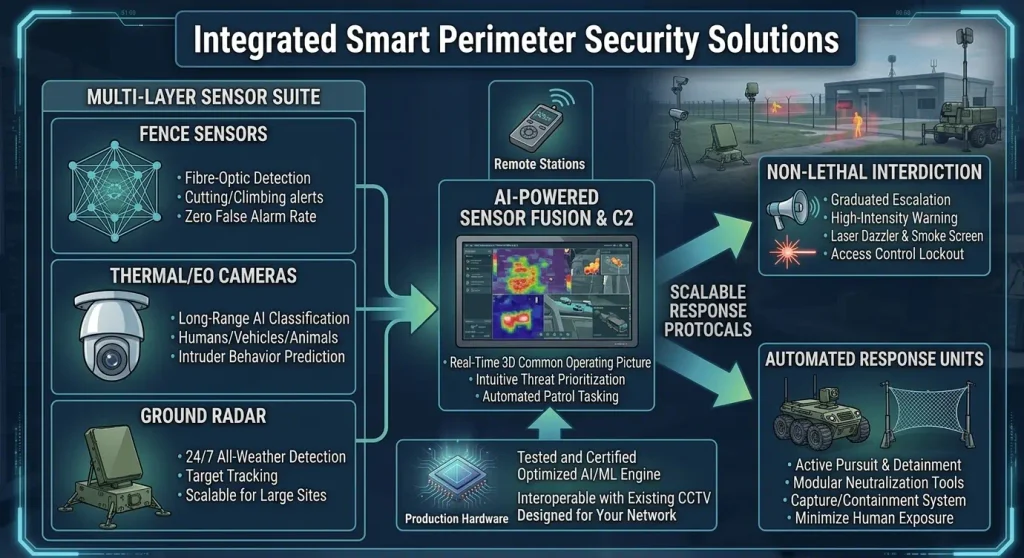
Commercial / Legacy Sensor Suite → RT Group Edge AI & Processing Logic → Multi-Spectral Detection → EO/IR & Radar Tracking → C2 & Sensor Fusion → Actionable Threat Intelligence

Radar and RF sensors detect and localize activity across wide perimeters. High-definition electro-optical and infrared (EO/IR cameras) confirm targets, while automated PTZ tracking locks onto high-priority threats dynamically. RT Group’s C2 layer fuses multi-source sensor data and manages the surveillance workflow end-to-end at the edge using targeted video analytics.

The result is a scalable, bandwidth-efficient architecture designed to significantly lower infrastructure overhead and speed up decision cycles—an intelligent platform built for operational environments where response latency, not raw data volume, is the priority.

High-Precision Video Analytics & Automated PTZ Tracking Capabilities

To maintain total situational awareness across expansive sites, our wide-area monitoring systems utilize intelligent automation to relieve operator fatigue and guarantee zero-miss threat detection:

  • Multi-Spectral Sensor Fusion: Seamlessly merging radar tracks with daylight and thermal feeds from multi-spectral EO/IR cameras for uninterrupted 24/7 visibility.
  • Automated PTZ Tracking: Utilizing AI-driven video analytics to continuously control motorized pan-tilt-zoom platforms, keeping fast-moving or occluded targets centered in real time (PTZ tracking).
  • Edge-Based Video Analytics: Running real-time object classification directly on edge nodes to filter out environmental noise (wildlife, weather, wave motion) before sending alerts.
  • Autonomous Wide-Area Monitoring: Scalable perimeter protection architectures capable of continuously scanning wide corridors with minimal network bandwidth.

Target Bandwidth & Operational Efficiency

By running full-stack video analytics directly at the sensor node, our solution drastically reduces network overhead while maintaining continuous wide-area monitoring:

MetricTraditional Raw Video StreamingRT Group Edge-AI Metadata Architecture
Data Rate10 – 50 Mbps per camera streamUnder 100 Kbps per sensor node
Bandwidth UsageHigh (demands dedicated fiber/microwave)Ultra-low (operates over narrow cellular/satellite links)
Operator OverheadHigh (manual visual triage required)Low (automated alerts via video analytics)
Sensor CoordinationManual target acquisitionAutomated PTZ tracking via C2 handoff
Potential Bandwidth & Overhead ReductionBaseline90 – 98% Reduction
System architecture infographic for "Integrated Smart Perimeter Security Solutions" displaying sensor input, central AI command, and response protocols.
Technology Stack
Edge AI Sensor Fusion Computer Vision Real-Time Embedded FPGA & RF Engineering EO/IR Processing Radar Signal Processing Zynq RFSoC Embedded Linux PREEMPT_RT
Capabilities

Multi-Sensor Fusion & Tracking

Real-time cross-correlation of EO/IR, radar, acoustic, and RF spectrum data into a unified, single-track operational picture.

Edge AI & Automated Target Recognition (ATR)

Ultra-low latency object classification and behavioral anomaly detection running directly on embedded edge hardware.

Tactical C2 & Sensor Tasking

Common Operational Picture (COP) integration featuring automated sensor handoffs, alert prioritization, and STANAG-compliant interfaces.

Low-Bandwidth Metadata Streaming

Edge data compression streaming high-confidence threat metadata (<100 Kbps) over satellite and constrained tactical radio links.

Modular Open Systems Approach (MOSA)

Vendor-agnostic sensor and platform integration using open standards (ONVIF, STANAG 4609, MISP) to prevent proprietary vendor lock-in.

Mission-Critical Embedded Reliability

High-throughput embedded computing architectures engineered to MIL-STD-810H standards for extreme environments and contested operations.

FAQ
Schedule Technical Consultation ↗
Services
19+
Years experience
200+
Projects delivered
2M+
Deployed devices
3
Global offices

Built to the standards this sector is audited against.

We engineer toward the standards your program is measured against, and produce the evidence its certification path depends on.

DO-178C

The global software standard for airborne systems; essential when software directly controls flight or mission-critical hardware.

DO-254

Design assurance for airborne electronic hardware.

IEC 62443

The global benchmark for OT/Industrial Automation and Control System cybersecurity.

Need a standard that is not listed? Compliance scope is defined per engagement. Talk to an engineer →

Counter-UAS Sensor Fusion