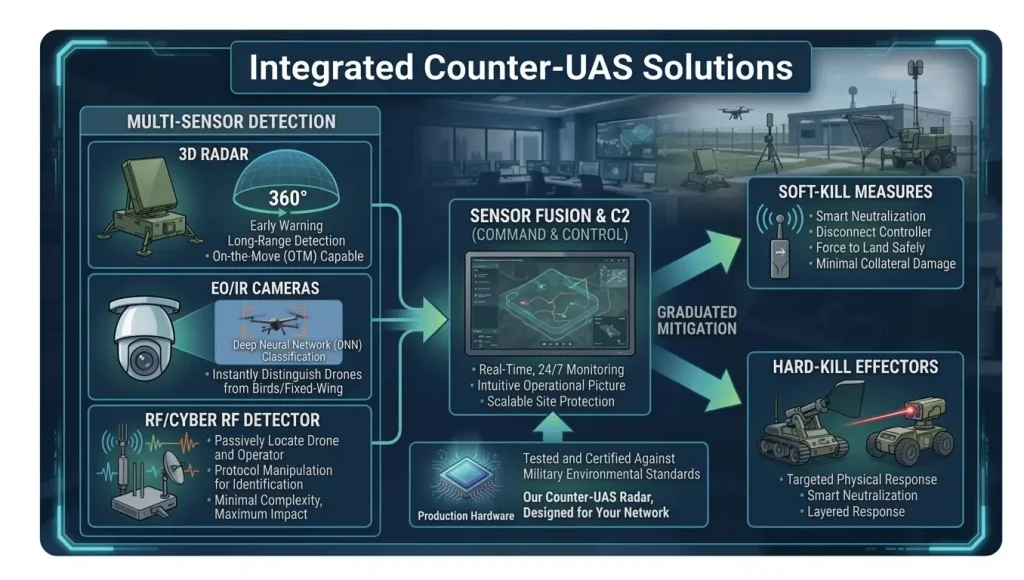
Counter-UAS is not a detection problem. Detection is the part of the chain that is already commoditized – an acoustic array or an RF sniffer will tell you something is in the air. The value sits in what happens in the seconds after: fusing scattered contacts into one track, separating a hostile platform from a friendly one, putting that decision in front of an operator, and closing the loop to an interceptor.
RT Group builds the full chain. Acoustic and RF mesh nodes, EO/IR classification, sensor fusion and tasking in a C2 ground station, human-in-the-loop validation, and integration with the response layer – engineered as one mission system rather than assembled from vendor boxes that do not talk to each other.
The same embedded, RF and edge-AI engineering that underpins our defense and aerospace work carries this platform: real-time software on constrained hardware, signal processing at the sensor, and a system architecture designed to survive the field rather than the demo.
Low-Cost Interceptor Architecture
The economics of counter-UAS are often inverted: a traditional dedicated interceptor can cost far more than the drone it is built to stop. Against a threat that is cheap, expendable and increasingly deployed at scale, that is an unfavorable cost exchange ratio – and one that does not hold up as drone threats multiply.
RT Group’s approach separates the expensive part of the problem from the cheap part. Instead of engineering a dedicated interceptor airframe from scratch, we pair a commercially available low-cost drone platform with RT Group’s real-time embedded, AI, sensor-fusion and command-and-control engineering. The R&D and the intelligence live in software, electronics and C2 – not in a custom-built airframe that has to be re-engineered for every mission profile.
The Architecture
Low-cost drone platform → RT Group Guidance & Control Logic → Radar / Acoustic Detection → EO Tracking → C2 & Sensor Fusion → Low-Cost Interceptor
Radar and acoustic sensors detect and localize the threat. EO confirms and tracks it. RT Group’s C2 layer fuses the sensor data and manages the engagement workflow end to end. The result is a scalable, cost-effective counter-drone architecture designed to significantly improve the cost exchange ratio against low-cost drone threats – an affordable Counter-UAS response built for a threat environment where volume, not unit sophistication, is the problem.
Target Cost Exchange Ratio
| Metric | Value |
|---|---|
| Traditional dedicated interceptor | $10,000 – $120,000 per unit |
| RT Group low-cost interceptor (target) | Under $1,000 per unit |
| Potential cost reduction | 80-95% |
These figures are engineering targets, not delivered pricing – they represent the architecture’s objective ahead of a working prototype and a validated bill-of-materials cost.