Production-Grade Edge AI & Computer Vision Engineering Solutions
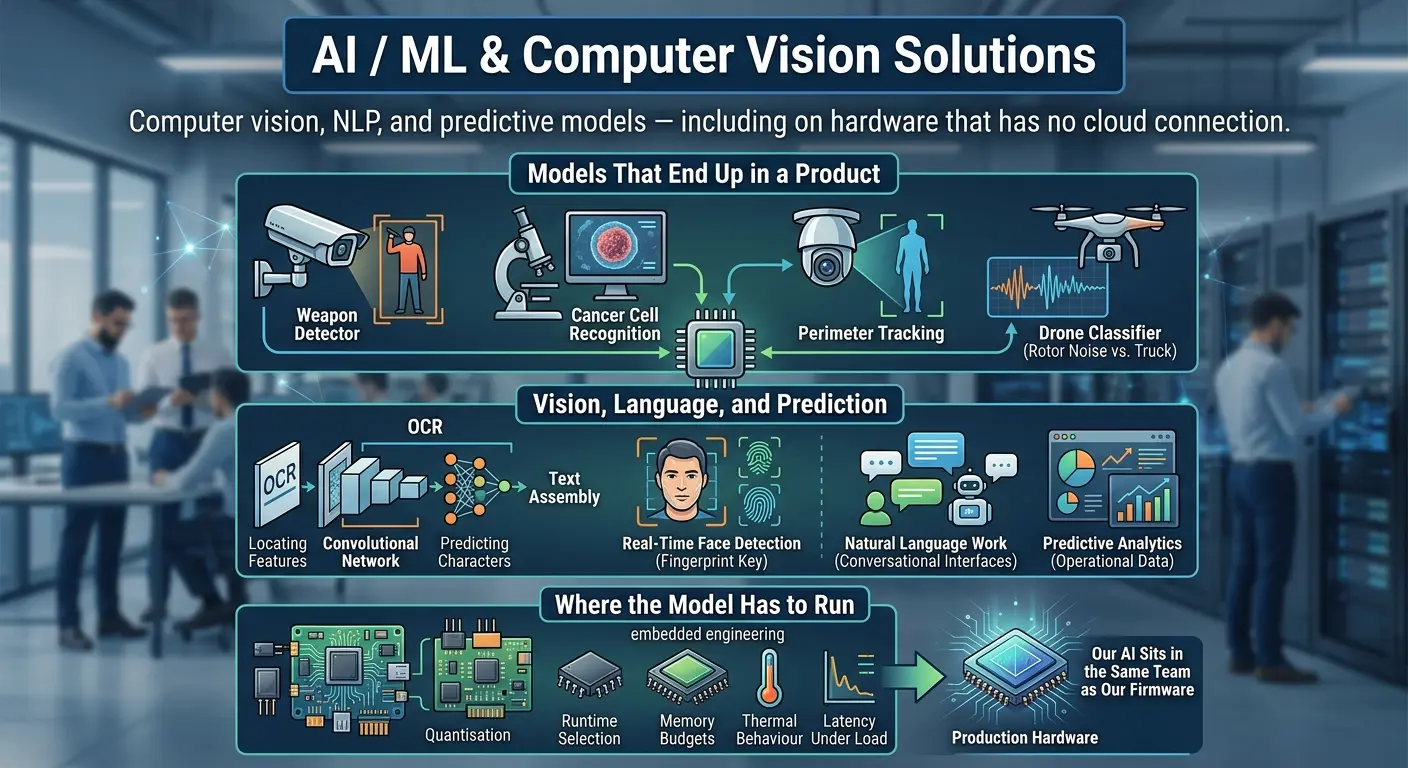
At Real Time Group, our machine learning engineering is built for real-world deployment, not just academic research. We specialize in taking complex deep learning models out of notebooks and engineering them into robust, high-performance edge hardware: a weapon detector securing public spaces, a diagnostic system recognizing cancer cells under a microscope, a PTZ platform tracking intruders across a perimeter, or an autonomous drone classifier separating rotor noise from ambient environmental sounds.
High-Performance Computer Vision Solutions for Industrial Edge Applications
Computer vision forms the core of our advanced artificial intelligence capabilities. By combining cutting-edge deep learning techniques with low-level embedded software engineering, we deliver real-time visual perception at the edge:
- Real-Time Object Detection & Tracking: Deploying lightweight detection pipelines for targets that are small, high-speed, or partially obscured across live video streams.
- Precision Classification Architectures: Building robust image and video classification pipelines optimized for medical imaging, industrial quality inspection, and defense surveillance.
- Optical Character Recognition (OCR): End-to-end vision pipelines leveraging deep neural networks—combining convolutional architectures for feature extraction, recurrent modules for sequential prediction, and CTC decoding for exact text reconstruction.
- Biometric & Facial Identification: High-speed face detection on live streams, optimized to act as secure, deterministic keys for access control and critical security workflows.
Beyond vision systems, our capabilities extend to lightweight Natural Language Processing (NLP) for conversational edge interfaces and time-series predictive analytics over operational sensor data.
Edge AI Optimization & Deep Learning Model Inference/Deployment
A deep learning model executing inside a Jupyter notebook is an experiment, not a product. Transforming raw models into real-time operational systems requires rigorous embedded engineering, hardware acceleration, and system-level optimization.
We bridge the gap between AI development and low-level system design. Our edge AI engineering team works alongside our firmware and kernel engineers to maximize efficiency across hardware platforms:
- Model Inference & Deployment Pipelines: We optimize, compile, and deploy models using frameworks like TensorRT, ONNX Runtime, OpenVINO, and TFLite for targeted hardware acceleration (NVIDIA Jetson, ARM Cortex-NPU, Hailo, and FPGA accelerators).
- Neural Networks Quantization & Pruning: We apply post-training quantization (INT8/FP16) and structural network pruning to minimize memory footprints while preserving high accuracy.
- Deterministic Latency & Resource Management: We strictly enforce tight memory budgets, prevent thermal throttling under heavy continuous load, and optimize CPU/NPU memory pipelines to ensure microsecond-level determinism during live model inference/deployment.
End-to-End Edge AI Engineering Capabilities
| Engineering Focus | Core Deliverables | System Impact |
| Model Optimization | Quantized Neural Networks (INT8/FP16) | Reduced RAM footprint, 3–5x faster execution |
| Computer Vision | Object Detection & Video Classification | High-frame-rate processing on low-power silicon |
| Edge AI Deployment | Embedded Model Inference/Deployment Pipelines | Sub-millisecond latency, zero cloud dependency |
| Hardware Abstraction | NPU/GPU Acceleration Drivers | Maximize throughput without thermal degradation |