n system-level software engineering, functionality is only half the equation—timing is everything. When hardware components fire signals or streaming data enters an edge node, execution delayed by even a few microseconds can mean dropped packets, out-of-sync control loops, or systemic hardware failure.
At Real Time Group, we engineer the critical layer where bare-metal hardware meets software. Our Linux kernel development and custom device drivers services are built specifically for high-throughput, mission-critical environments where determinism, speed, and strict time constraints are non-negotiable.
Tailored Linux Kernel Development & Kernel-Level Hardware Integration
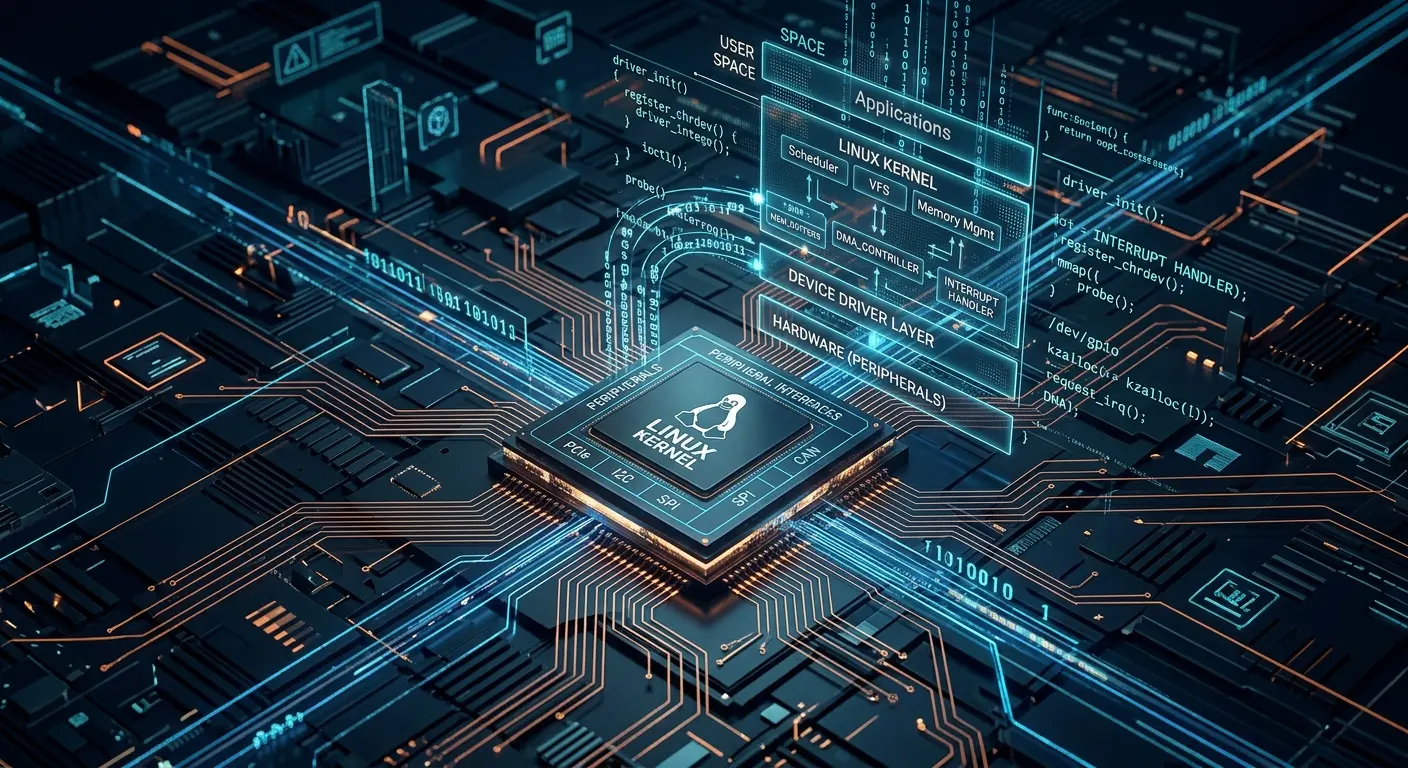
Writing software inside Linux kernel space requires deep familiarity with hardware registers, interrupt vectors, virtual memory management, and kernel lock primitives. Standard generic drivers rarely deliver the performance needed for custom printed circuit boards (PCBs) or specialized SoCs.
We develop production-grade kernel modules that execute natively inside the Linux kernel, bypassing user-space overhead to establish direct, low-latency control and achieve seamless kernel-level hardware integration across your physical interfaces.
Core Capabilities in Kernel Modules & Custom Device Drivers
Our low-level software teams handle complex kernel-space development across standard and proprietary hardware interfaces:
Custom Device Drivers & Kernel Modules (Character, Block & Network)
We write, test, and debug proprietary kernel modules and custom device drivers tailored to non-standard hardware. Whether configuring custom character devices, block storage subsystems, or high-speed Network Interface Cards (NICs), we build clean, maintainable code structures designed for production longevity.
High-Speed DMA & Direct Memory Access Pathways
For bandwidth-heavy applications such as video streaming, radar data processing, or high-frequency telemetry, we design zero-copy Direct Memory Access (DMA) pipelines. This offloads data transfer from the CPU during kernel-level hardware integration, reducing latency and maximizing data throughput.
Hardware Interrupt Handling & IRQ Optimization
We engineer top-half and bottom-half interrupt architectures using workqueues, tasklets, and threaded IRQs within the Linux kernel. This prevents interrupt starvation and maintains system responsiveness under heavy hardware load across all custom drivers.
I2C/SPI/UART Peripherals & Industrial Bus Integration
We specialize in driver development for low-level I2C/SPI/UART peripherals, as well as high-speed buses including PCI Express, CANbus, USB, and custom FPGA-to-CPU memory interfaces. Our solutions establish robust abstraction layers for user-space applications through clean kernel-level hardware integration.
Real-Time PREEMPT_RT Kernel Patching
When hard real-time execution is required, we integrate and tune the PREEMPT_RT patch set inside the Linux kernel, transforming standard Linux into a deterministic operating system capable of microsecond-level response times for critical kernel modules.
Kernel & Driver Engineering Lifecycle
We manage custom low-level software development using a rigorous process to ensure memory safety, system stability, and upstream maintainability.
| Phase | Core Deliverables | Engineering Focus |
| 1. Architecture & Spec | Memory Map, Register Layout | Hardware register analysis, bus selection (I2C/SPI/UART peripherals), IRQ routing plan |
| 2. Module Engineering | Kernel Modules (.ko), Custom Device Drivers | Kernel-space code, sysfs/procfs interfaces, lock architecture |
| 3. Hardware Bring-Up | Oscilloscope/Logic Traces | Physical board debugging, kernel-level hardware integration, register validation, boot tracing |
| 4. Performance Tuning | Latency Profiling, Stress Logs | Zero-copy DMA optimization, IRQ latency reduction, memory leak audits |
| 5. Integration & Delivery | Source Tree, Build Scripts | Clean API abstraction, Yocto/Buildroot recipe integration for kernel modules |