Security that was designed in
Firmware security tends to arrive late — usually when a customer asks how images are signed, or when a device is found to be physically reachable by people nobody vetted. Retrofitting a boot chain at that point is expensive, and the pieces required are nearly always the same.
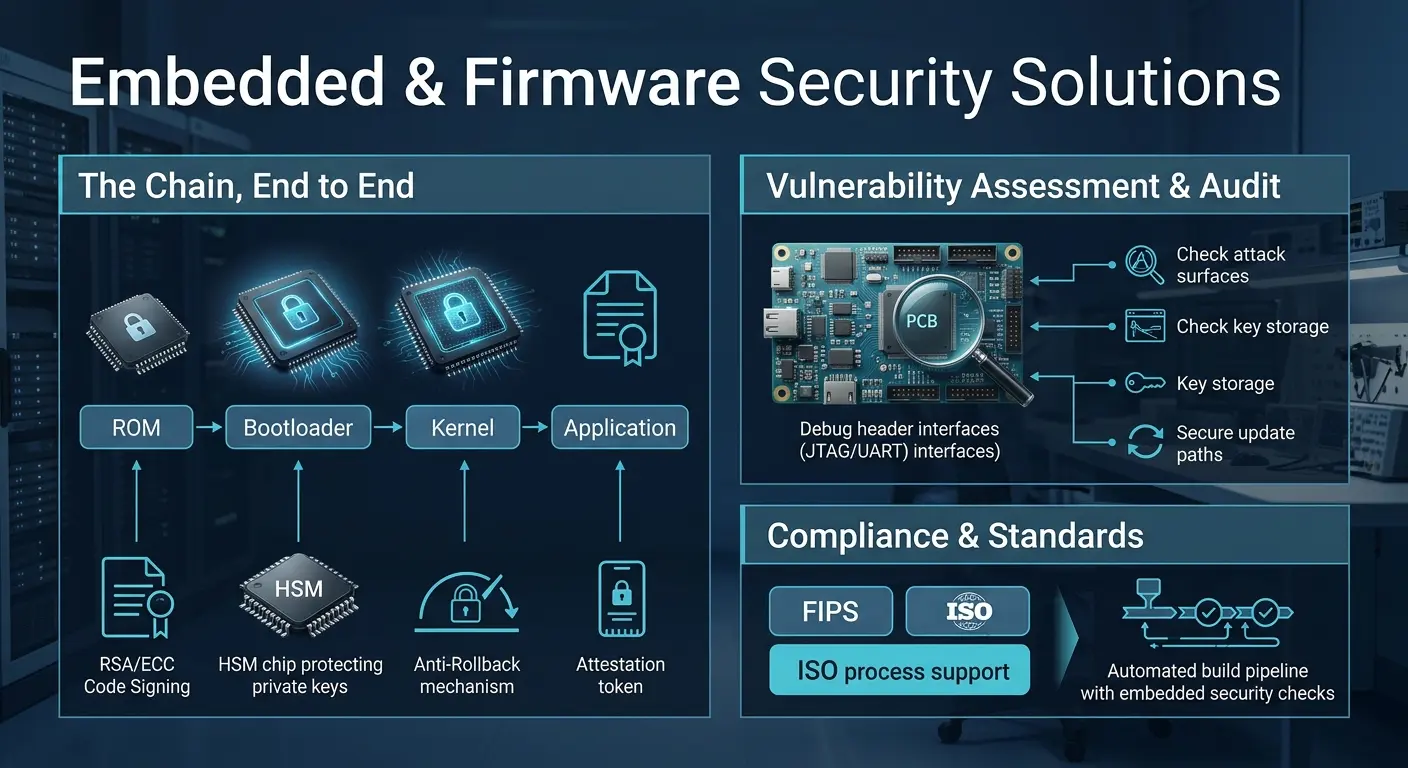
The chain, end to end
A verified boot chain where each stage authenticates the next. Image signing with RSA or ECC, wired into the pipeline so every build is signed without a manual step. Keys generated and held in an HSM, never present in a build artefact. Anti-rollback so a device refuses an older, vulnerable image. Attestation so it can prove in the field what it is running.
Assessment of what already exists
For devices already designed or already shipped, we start with a review: attack surface, update path, debug interfaces, key handling, and what an adversary recovers from hardware they physically hold. The result is a prioritised list of what to fix, in the order that reduces risk fastest.
Where this comes from
This is not a separate practice bolted on. It comes out of defense and medical programmes where firmware provenance had to be demonstrable, and out of the toolkit our own engineers use on that work.